


You are about to make a five-figure decision on vibes: a portfolio that looks expensive, a call that feels good and a proposal full of sentences nobody can quite test.
Every guide tells you to “review their portfolio” and “assess their website.” Fine. How? What should you click, which number matters and when does the obvious test lie to you? This guide gives you a ten-minute procedure using free tools—and, just as importantly, tells you what each result does not prove.
The disclosure belongs near the top: Remonthub is a web design and development agency. We benefit if somebody reading this hires us. That is why section nine tells you when not to hire an agency, and why every test below can be run on us too.
1. Decide what you are actually buying
“We need a new website” can describe four different products. If you do not separate them before requesting proposals, one agency quotes a customised template, another quotes original design and a third quietly includes a software product. Comparing the totals is then theatre.
| What you need | What it really is | Illustrative planning range (USD) |
|---|---|---|
| A brochure site | About 5–8 pages, template-led, with routine edits handled by you | $2,000–8,000 |
| A custom marketing site | Bespoke design, CMS, conversion paths, analytics and launch support | $8,000–30,000 |
| An ecommerce build | Catalogue, checkout, payments, shipping, tax and integrations | $15,000–75,000 |
| A web application | Accounts, permissions, custom logic, data and a maintained backend | $40,000+ |
Illustrative starting budgets for agency work, not universal market rates. Content volume, migration, integrations, accessibility work, QA, support and geography can move a project well outside them. Compare current marketplace data from Clutch's web-design pricing guide before setting a final budget.
A web design agency may cover research, information architecture, UX, visual design, copy, development, testing and post-launch support—or only the first half of that sentence. Put the deliverables in writing. “Website design” is not a scope.
2. The 10-minute agency fact-check
Do this before a second call. The goal is not to catch somebody out; it is to replace vague claims with better questions. All six checks are free.
Test 1: Accessibility—start here
Open the agency's homepage in Chrome, press F12, choose the Lighthouse tab and run a mobile report. PageSpeed Insights exposes the same Lighthouse accessibility category without DevTools. A score of 90–100 is a good automated result; 50–89 means there is work to investigate; below 50 is poor.
Accessibility is often a stronger agency-screening signal than a raw speed score because contrast, names, labels, heading structure and keyboard behaviour are substantially shaped by design and build decisions. It is still page-specific: cookie banners, third-party widgets and later content changes can introduce failures after launch. It also matters commercially: the US Department of Justice says businesses open to the public must make their online goods and services accessible.
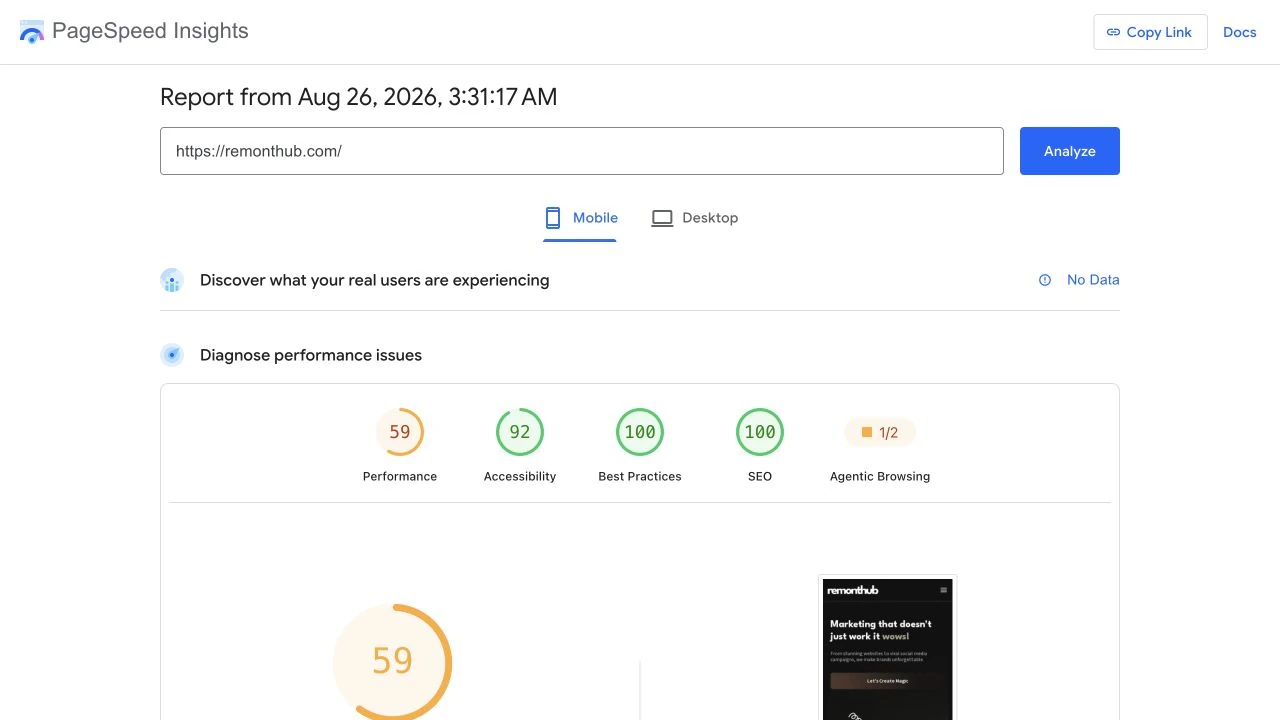
What this suggests: the page passed most of Lighthouse's weighted automated accessibility audits in that run.
What it does not prove: that the whole site conforms to WCAG or complies with the ADA. Lighthouse itself encourages manual testing, and both the DOJ and W3C warn that automated tools cannot catch everything.
Read the official Lighthouse scoring method, W3C guidance on evaluation tools and US Department of Justice web-accessibility guidance. This is practical screening advice, not legal advice.
Test 2: Speed—useful, but only when read correctly
Run the agency's own site and two live portfolio sites through PageSpeed Insights. For a quick screen, rerun any surprising result. Before making a serious technical judgement, run five comparable tests and use the median; Lighthouse is a simulated lab run and scores vary with the test environment.
A weak number is not automatically the agency's fault. Three legitimate explanations:
- The client added analytics, advertising, chat and tracking scripts after launch.
- The client knowingly chose heavy video, 3D or animation because the experience mattered more than a perfect lab score.
- The agency designed the site but a different company developed or now maintains it.
Open the diagnostics. Agency-controlled issues can include oversized images, inappropriate loading priorities, render-blocking code, excessive JavaScript and poor caching. Third-party scripts and infrastructure may sit elsewhere. Then ask the agency to explain what you are seeing. The most revealing result is often the reaction: a good team gives you context and trade-offs; a weak team gets defensive or cannot distinguish field data from a lab run.
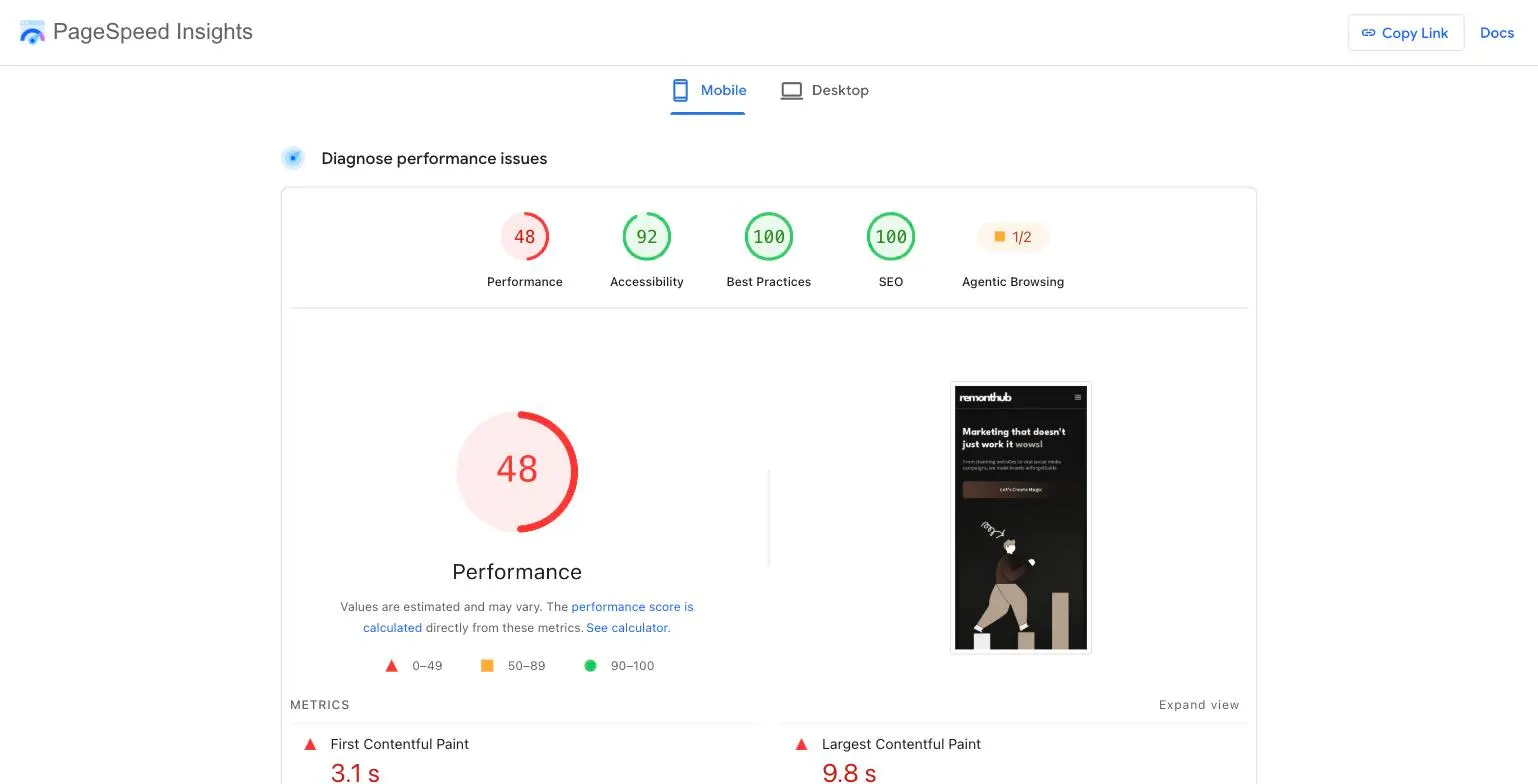
We published that 48 before anyone asked. If you want the plain-English version of the metrics, read what LCP and Core Web Vitals actually mean. Google's PageSpeed documentation separates historical real-user field data from a single controlled Lighthouse lab test.
Test 3: Are the portfolio sites still live?
Click every example you care about. Dead links, parked domains and broken layouts need an explanation. They do not automatically mean the agency failed—the client may have rebranded, closed or replaced the site—but a portfolio full of unverified screenshots tells you very little. Two live, relevant builds beat twenty mockups.
Test 4: Who actually built the work?
Look for detailed case studies and, where present, footer credits. Then ask directly: “On this project, did you handle strategy, design, development or all three?” Credits are clues, not proof. The point is to stop buying somebody else's engineering under a vague “we made this” claim.
Test 5: Spot-check search visibility
Search Google for site:theiragency.com and browse the results. This is a rough discovery check, not a reliable count—Google says search operators are limited and results are not exhaustive. But if you find only a homepage, old staging URLs or obvious duplicates, ask how the agency handles launch indexing, redirects, canonicals and Search Console handoff. We learned those questions the hard way; here is why some sites never show up on Google.
Test 6: Open it on your phone
Do not merely shrink a desktop window. Use the agency site and its best portfolio work on your phone. Open the menu, complete a form, read a long page and try the primary action with one thumb. Google primarily crawls and indexes what its smartphone crawler can access, so mobile content parity matters. Your buyers are less patient than Googlebot.
See Google's mobile-first indexing guidance. Mobile-first describes what Google gathers; it is not a standalone design-quality score.
The scorecard
| Test | Tool | Encouraging result | What it does not prove |
|---|---|---|---|
| Accessibility | Lighthouse / PSI | 90+ with no severe automated failures | WCAG conformance or ADA compliance |
| Speed | PageSpeed Insights | Agency explains diagnostics and trade-offs clearly | That every slow item was the agency's decision |
| Live work | Portfolio links | Recent, usable sites with context | That the agency did every part of the project |
| Role | Case study + direct question | Specific scope, team and contribution | That the same people will work on your project |
| Visibility | Google site: search | Sensible, clean examples appear | The exact number of indexed pages |
| Mobile | Your own phone | Key tasks are easy without zooming or hunting | Coverage across every device and assistive technology |
3. Read a portfolio properly
Relevance beats volume. If you sell complex B2B services, fifty restaurant templates do not prove the team can explain your offer. Look for a comparable buying journey, content depth, integration or operational constraint—not merely the same colour palette.
- Range: do the sites solve different problems, or does every client receive the agency's house style?
- Outcomes: does the case study name a business goal and evidence, or only fonts and screenshots?
- Recency: were the strongest examples launched this year, or are they carrying a five-year-old reputation?
- Continuity: is the live site still recognisable, maintained and usable?
Then account for the junior-swap. The people who created the celebrated portfolio piece may not be the people assigned to you. Ask who worked on the exact example you liked and who will work on yours. Agency size should roughly fit project size: the smallest client can get the B team; the largest can become a learning exercise.
4. How to actually check references
“Please send three references” is close to useless. Every agency sends the three happiest clients. Keep the references, but change the questions.
- What went wrong, slipped or changed—and how did the agency handle it?
- Was the final invoice close to the proposal? Which extras appeared?
- Did the senior people from the pitch remain involved?
- Could your team edit the site and access every account after launch?
- What was month three like, once launch-day attention disappeared?
Next, choose one public portfolio client the agency did not nominate and ask a short, respectful question. Read employee reviews for recurring patterns around churn, management and overwork; a stressed revolving team will eventually become your delivery problem. Ask the agency for one project that went badly and what changed afterward. A specific failure story is more credible than a flawless highlight reel.
Treat online recommendation threads carefully too. Agency-selection discussions attract agencies, affiliates and newly created accounts recommending themselves. We say that as an agency publishing an agency-selection guide. Use those threads for questions and failure modes—not as your final shortlist.
5. The questions worth asking—and the answers that should worry you
| Question | A useful answer | An answer that should worry you |
|---|---|---|
| Who is actually doing the work—and can I meet them? | Names, roles, availability and a short introduction before signing | “Our team” with no names, or access only through sales |
| Will any part be subcontracted, and to whom? | What, why, where, who owns QA and whether you can speak to them | “We handle everything” followed by silence on delivery staff |
| Will the domain, hosting and admin accounts be in my name? | Yes, from day one, with your company as owner and the agency as an invited user | “We keep it under our account because it is easier” |
| Can my team make routine content changes? | A demo of the CMS, permissions and handover training | Every text or image change becomes a paid ticket |
| Why this design? | User evidence, content priorities, measurable hypotheses and a plan to learn after launch | “We have twenty years of experience” offered instead of reasoning |
| What happens in month three? | A named support route, response times, included hours and visible backlog | “We are always here” with no scope or service level |
| What happens when we go over scope? | Written change control, rate, impact and approval before work starts | Vague “flexibility” or surprise billing after the fact |
| Can we begin with a small paid trial? | A defined discovery, prototype or landing-page phase with usable output | A large non-refundable deposit before you have worked together |
The paid trial is the shortcut. Two weeks of real decisions reveals communication, judgement and pace better than a fifty-slide proposal. Pay fairly, define an output and keep the option to stop.
If the scope is a redesign, ask these migration questions before you sign.
6. Red flags that survive the sales call
- Your domain is not registered in your company's name.
- You do not receive hosting, repository and CMS access from the start.
- The CMS is technically present but every routine edit still requires the agency.
- They guarantee rankings or promise a full custom redesign in four weeks.
- They quote before asking about users, content, integrations, approvals or success.
- They will not name the delivery team, or the names keep changing.
- Calls are stacked with people who neither decide nor contribute.
- Experience is cited whenever you ask for reasoning.
- The portfolio has screenshots but no live links or clear project roles.
- A template-led process is being sold as bespoke design.
None of these alone proves bad intent. Together they describe a business model built around dependency: you cannot leave, cannot edit and cannot reach the people doing the work. Ownership is not an after-launch favour. It is part of the initial architecture.
7. Agency, freelancer or in-house?
| Factor | Freelancer | Agency | In-house |
|---|---|---|---|
| Cost | Usually lowest overhead | Higher, paying for several disciplines and management | Highest fixed commitment once salaries and tools are counted |
| Capacity | One person's skills and calendar | Can combine strategy, design, development and QA | Deep focus on your business, limited by who you hire |
| Speed | Fast on a small, clear scope | Parallel work can accelerate larger builds | Fast decisions after the team is hired and onboarded |
| Main risk | Single-person availability and uneven skill coverage | Junior swap, account layers and hidden subcontracting | Hiring time, fixed cost and gaps between specialists |
| If one person disappears | The project may stop | A credible agency supplies continuity | The company recruits or redistributes work |
| Best fit | Small, defined site with an involved client owner | Multi-disciplinary build with a launch date and support needs | Continuous roadmap central to revenue or operations |
A good freelancer is not a budget version of an agency. For a focused five-page site, they may be the sharper choice: less ceremony, direct communication and no account-management layer. Hire an agency when you genuinely need multiple disciplines or continuity. Build in-house when the website is an evolving product, not a project.
8. Local, remote or offshore—the question nobody answers straight
A useful admission surfaced in the practitioner discussion that shaped this guide: some Western agencies subcontract execution to lower-cost teams without making those people visible to the client. So the real first question is not “Should we go offshore?” It is “Do we know who is already doing the work—and are we paying a markup for not being allowed to speak to them?”
Offshore can mean materially lower cost for equivalent capability, a larger talent pool and direct access to experienced builders without a heavy account layer. It can also mean timezone friction on urgent fixes, harder cross-border credential checks, more complicated contract enforcement and enormous quality variation. The low-end template trap is real: a provider minimises its effort by forcing every client into the same structure while calling the result custom.
De-risk any geography: start with a paid trial, pay by milestones, put custom-work IP transfer in writing, list licensed fonts, plugins, stock assets and open-source components separately, keep domain and hosting ownership in your company, name a contact with working-hour overlap and insist on direct access to the people doing the work.
Geography changes the economics; transparency changes the risk. Compare what offshore web development really costs with the honest guide to outsourcing web development before treating “local” as a quality guarantee or “offshore” as a warning label.
Practitioner themes in this article were paraphrased from a public r/web_design agency-selection discussion. Individual comments are experiences, not universal evidence.
9. When you should not hire an agency at all
Do not hire one because a competitor launched a shiny redesign. A three-page Squarespace or Shopify site may genuinely solve your problem. Do not commission a custom build when you cannot state what it should help a visitor do, when nobody internally can approve decisions or when the build consumes every dollar and leaves nothing for content, maintenance or distribution.
We have turned down projects for versions of those reasons. That is not sainthood; unclear, ownerless and underfunded projects are unpleasant for everyone and rarely become good portfolio work. A smaller first phase is better than a larger promise both sides already know is fragile.
10. A realistic selection timeline
For a typical small-to-mid-sized business, allow three to five weeks: one week to define the outcome and scope, one week to shortlist and run the checks, one to two weeks for calls and proposals, and a final week for references, contract detail and a paid first phase. Enterprise procurement, security and legal review can take much longer.
If cash flow is tight, phase the build around the first useful release: home, services and booking first; long-form resources or secondary tools later. Make each phase independently useful. “Phase two” should be a choice, not a threat hanging over a half-built website.
11. Questions we get a lot
How do I choose a web design agency?
Define the outcome and scope first, then shortlist agencies with relevant live work. Run a quick accessibility, speed, mobile and indexing check; verify who actually did the work; speak to references using pointed questions; and start with a small paid phase before committing to the full build.
What should I look for in a web design agency?
Look for relevant outcomes rather than a large gallery, clear reasoning behind design decisions, named people who will work on your project, transparent subcontracting, ownership and admin access from day one, a usable CMS, and a specific post-launch support plan.
What questions should I ask before hiring a web design agency?
Ask who will do the work, whether any part is subcontracted, who owns the domain and accounts, what you can edit yourself, why the proposed design should work, how scope changes are priced, what support looks like after launch and whether you can begin with a paid trial.
How much should a website cost?
A template-based brochure site may cost about $2,000–8,000, a custom marketing site $8,000–30,000, an ecommerce build $15,000–75,000 and a web application $40,000 or more. These are planning bands, not quotes; content, integrations, migration, accessibility, QA and support can move the number substantially.
Is it safe to hire an offshore web design agency?
It can be, if the team is visible and the engagement is structured properly. Use a paid trial, milestone payments, written IP transfer, client-owned accounts, a named contact with working-hour overlap and direct access to the people doing the work. Geography changes cost and collaboration; process determines most of the risk.
Should I hire a freelancer or an agency?
A good freelancer is often the better choice for a small, well-defined site when you can manage the work and tolerate one-person availability risk. An agency makes more sense when the project needs strategy, design, development, content, QA and ongoing support under one accountable team.