

If you run a business but didn't come up through marketing, SEO is genuinely confusing—and most articles about it are written by marketers, for marketers, in a language that assumes you already know what a SERP is.
This one isn't. No jargon, no acronym soup. Most screenshots below are from our own site, including the ones that do not flatter us; the ecommerce comparison is clearly labelled.
Here is what a decision-maker actually needs: what the three types of SEO are, what Core Web Vitals mean, why rankings move when nobody touched anything, what the tools cost and what team you need.
1. What SEO actually is—in one sentence
That is it. Not magic and not hacking Google. A search engine's job is to surface the most useful result for a search. SEO is the work of making your website a strong result—and making sure the engine can reach and understand it.
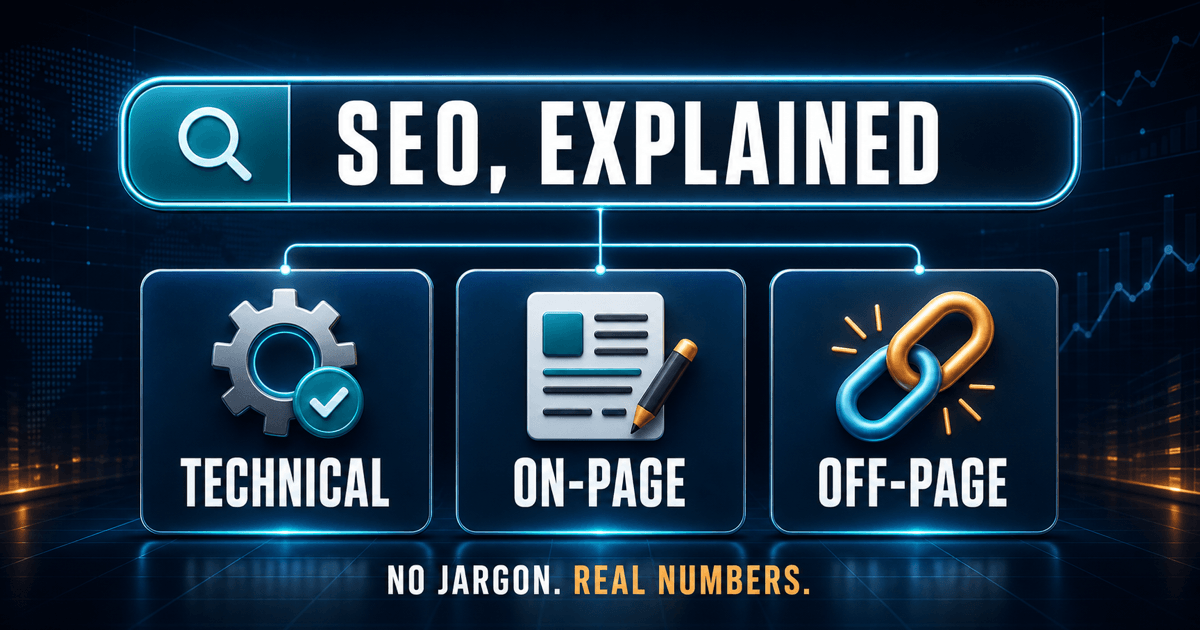
The industry splits that work into three buckets. If you learn only one thing from this article, learn these three terms, because every agency and SEO hire will use them.
| The bucket | Plain English | Who does it | Example tasks |
|---|---|---|---|
| Technical SEO | Can Google reach, read and load my site properly? | Usually a developer | Speed, mobile usability, indexing, sitemaps, broken links and structure |
| On-page SEO | Does each page clearly answer what people search for? | Content and marketing | Content, titles, headings, descriptions, images and internal links |
| Off-page SEO | Does the rest of the internet vouch for my site? | Senior marketing and PR | Relevant backlinks, mentions, digital PR and reputation |
A useful mental model: technical SEO is the plumbing, on-page SEO is what you serve, and off-page SEO is your reputation. A restaurant with broken plumbing fails no matter how good the food is. Great plumbing with bad food also fails. And a place nobody has heard of can take time to earn attention, however good it is.
2. Technical SEO—can Google actually use your site?
This is the foundation, and it is mostly invisible to customers. If it is broken, the rest of what you spend money on may never get a fair chance.
- Indexing: is your page in Google's searchable database? A page that is not indexed cannot appear in search. We had 59 pages excluded on our own site; here is the full story of why websites don't show up on Google.
- Crawlability: can a search bot reach every page it should, and is it kept away from URLs it should not crawl?
- Site speed and Core Web Vitals: whether key pages load and respond well, especially on mobile.
- Mobile usability: Google primarily uses the mobile version of a site for indexing and ranking.
- Site structure: a logical hierarchy that helps people and search engines understand what matters.
- Duplicates and canonicals: consistently signalling which version of a page is the primary one.
Planning a rebuild? Read redesigning without losing your rankings first.
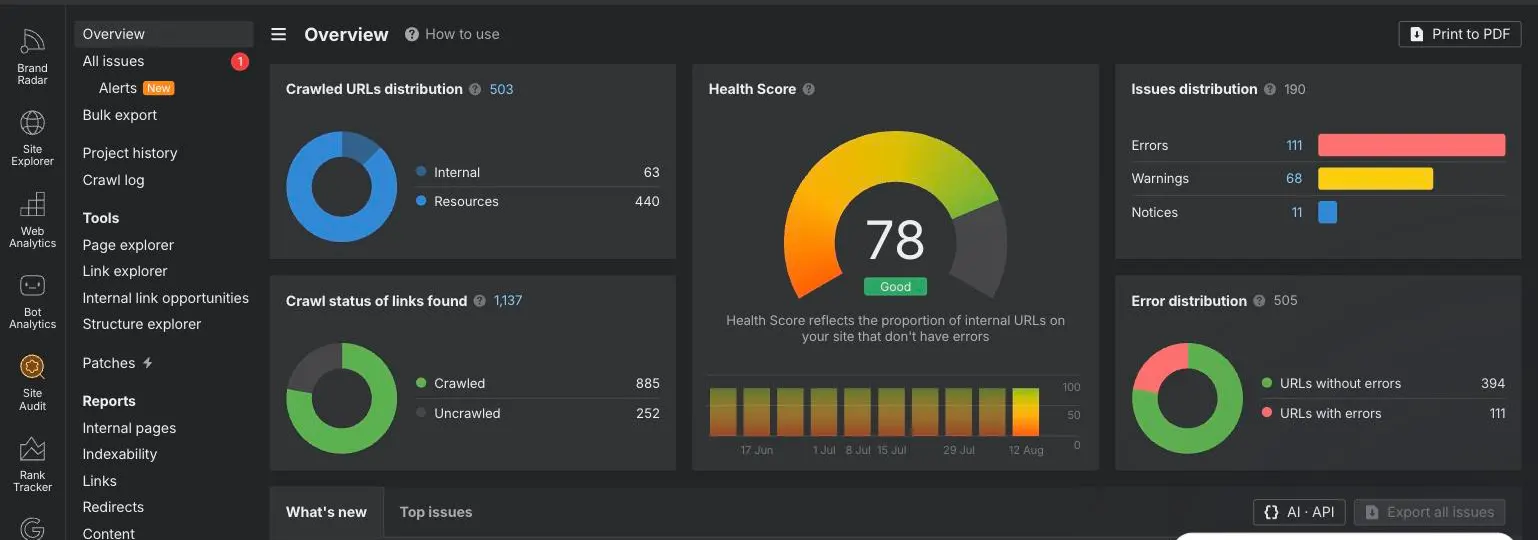
Read that audit the way a non-marketer should. The leading items included meta descriptions that were too long, title tags that were too long and URLs to submit through IndexNow. None is a mysterious verdict: the audit turns technical SEO into a prioritised list. Ask your team to show you theirs. If they cannot produce one, ask what they are using to guide the work.
3. Core Web Vitals—the part every MD should understand
Core Web Vitals are Google's three measurements of whether a page gives visitors a fast, responsive and visually stable experience. Google evaluates the 75th percentile of page visits, separated by mobile and desktop.
| Metric | What it measures | Plain English | Good score |
|---|---|---|---|
| LCP Largest Contentful Paint | How long until the main content appears | “How long am I waiting for the main thing?” | 2.5 seconds or less |
| INP Interaction to Next Paint | How quickly the page responds to an interaction | “I tapped the button. Did anything happen?” | 200 milliseconds or less |
| CLS Cumulative Layout Shift | How much the layout unexpectedly moves | “I went to tap a link and the page jumped.” | 0.1 or less |
You may also see FCP—First Contentful Paint—which records when the first content appears rather than the largest visible content. Google says Core Web Vitals are used by its ranking systems, but there is no single page-experience signal and relevance can outweigh page experience. Treat performance as part of a useful page, not a shortcut to first place.
The commercial reason is simpler: visitors can leave a slow page before it has a chance to persuade them. That lost attention may matter more to a business than a small ranking movement.
What Google's tools show on real websites
For context before looking at Remonthub's lab result, we ran Google PageSpeed Insights on Nykaa's public ecommerce homepage. Here is its mobile field report:
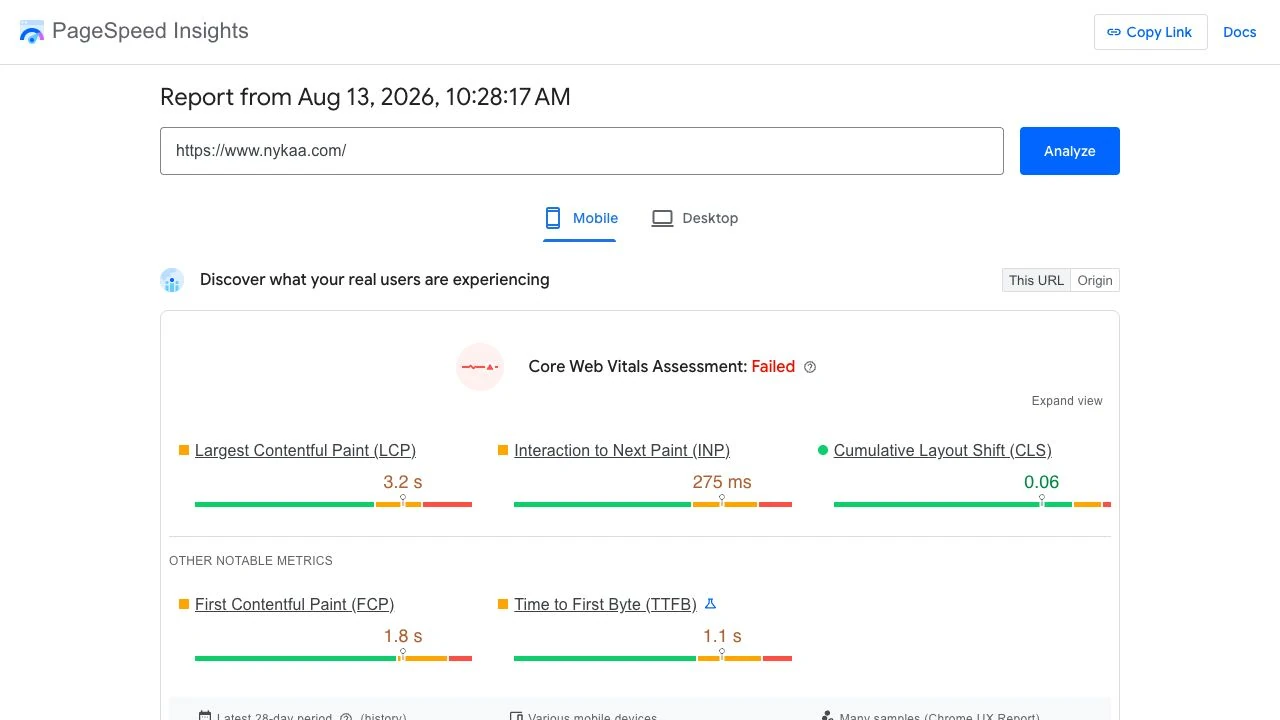
Search Console uses field data from real Chrome visits in the Chrome UX Report. A new property—or a URL group without enough eligible data for the relevant device type—can show no data. That was the status on our site when we checked. Small and low-traffic sites commonly encounter this, but low traffic is not the only possible reason.
PageSpeed Insights can still run an on-demand Lighthouse lab test. Its field-data section also depends on available Chrome UX Report data, so understand which half of the report you are reading.
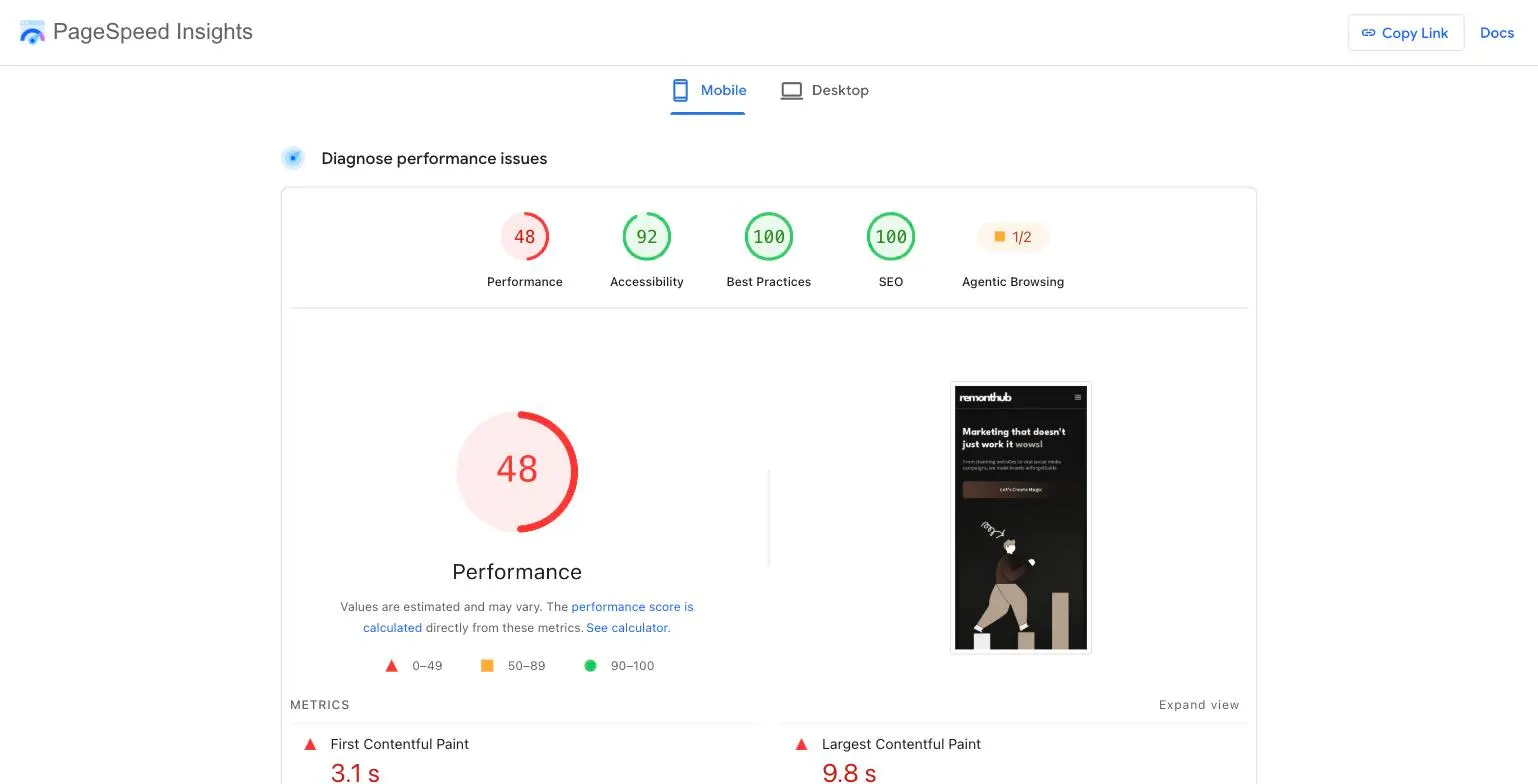
Let us not dress that up. The lab test showed 9.8 seconds for the largest contentful paint, against a good threshold of 2.5 seconds or less. We are a digital agency showing you our own bad number because the useful response is not embarrassment; it is a concrete improvement plan.
What to ask your team: “Run PageSpeed Insights on our homepage and top three landing pages. Show me mobile, not only desktop. What is our LCP, and what is the plan?” A competent team can answer without hiding behind the acronym.
4. On-page SEO—does the page answer the question?
On-page SEO is everything on the page itself. It is the bucket with the most ongoing work and the one many businesses under-invest in.
- The content: does the page give a genuinely useful answer to what someone searched for? This is not a keyword-density exercise.
- Title tag and meta description: the headline and summary that can appear in search results—your search-result pitch.
- Headings: a structure that helps readers scan and search engines understand the page.
- Internal links: descriptive links that connect related pages and show which URLs your own site considers important.
- Images: appropriately compressed and described in useful alternative text.
- Search-intent match: if useful results for a query are guides and yours is only a sales page, the format itself may be wrong.
We got this wrong on 17 portfolio entries that had a heading, images and no meaningful explanation. Google crawled them and left them out of the index. That was an on-page failure, not something speed optimisation alone could fix. We documented the whole episode in what "crawled – currently not indexed" really means.
5. Off-page SEO—does anyone else vouch for you?
Off-page SEO is mostly about backlinks: links from other websites to yours. A relevant editorial link from a respected publication is a credible recommendation. Large batches of low-quality directory links are not an equivalent substitute and can create risk when they are built to manipulate rankings.
This is usually the slowest and most relationship-heavy part of SEO—and the area where vague deliverables are easiest to sell. Credible links are earned through useful work, original information, real partnerships and good outreach.
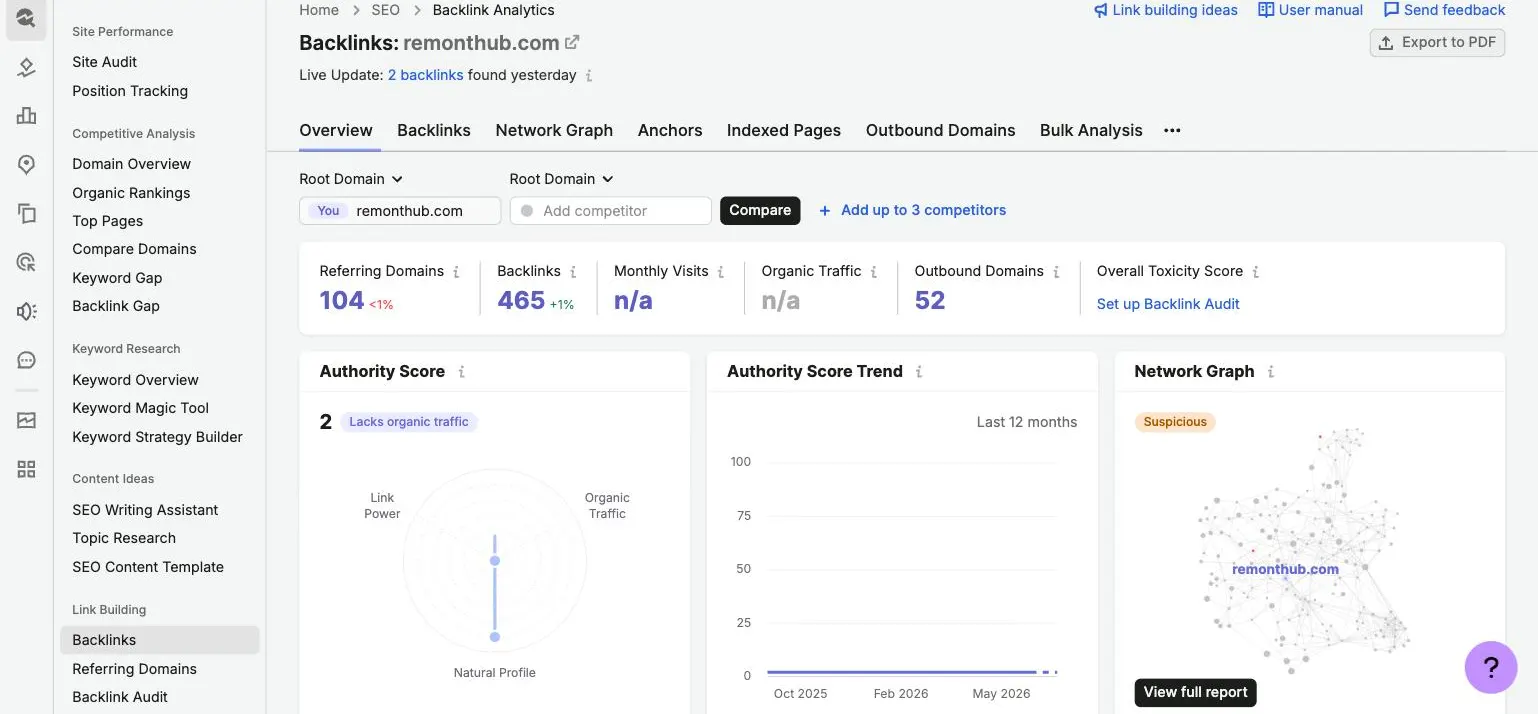
- Referring domains add context to the raw backlink count. Here, 465 links came from 104 domains, so some sites linked more than once. Look at the quality and relevance of those distinct sources, not only the largest number.
- An authority score is a tool's estimate, not a Google metric. Different platforms can score the same domain differently. Use the number to observe direction inside one tool, not as an official grade.
- Links do not guarantee useful visibility. “Lacks organic traffic” beside a backlink count is a reminder to connect link work to actual non-branded queries and qualified visitors.
This distinction also explains pages that are indexed but never rank: eligibility is only the starting point; the page still has to earn visibility against every competing result.
What to ask: “How many relevant referring domains did we earn last quarter, and where from?” A useful answer names and evaluates the publications rather than reporting a bulk link total.
6. Why rankings move when nobody touched anything
You changed nothing, but organic traffic dropped 30%—or jumped. Google changes its ranking systems throughout the year and launches broad core updates several times annually. Those updates are not targeted at one site; they can change which pages best satisfy the systems' assessment.
Think of a competition whose judging criteria evolve. Your page may be unchanged while another result becomes more useful, more original or better aligned with what searchers need.
- Check timing before blaming a person. Compare the change with Google's Search Status Dashboard, then allow about a week after a rollout finishes before analysing the full effect.
- There is no core-update repair button. Assess the pages that lost ground and improve them for people rather than trying to reverse-engineer one signal.
- Recovery has no fixed schedule. Some changes can be reflected in days; others may take months or a later update, and improvement does not guarantee the previous position.
- Judge trends, not daily noise. Use a three-month view and compare year over year where seasonality matters.
If traffic falls and stays down with no ranking update that explains it, investigate. The cause may be technical—see why sites go invisible on Google—or the affected pages may no longer be the most useful result.
7. What the tools cost—real August 2026 numbers
The free tools that do the essential job
| Tool | Cost | What it does | Bucket |
|---|---|---|---|
| Google Search Console | Free | Queries, indexing, crawl and page-experience reports from Google | Technical + on-page |
| PageSpeed Insights | Free | On-demand Lighthouse lab testing plus CrUX field data when available | Technical |
| Google Analytics | Free | What visitors do after they arrive | All |
| Google Business Profile | Free | Local search and Maps presence | Off-page |
| Bing Webmaster Tools | Free | Bing indexing, search performance and AI-citation reporting | Technical + on-page |
A small business can do meaningful SEO with those free tools. Paid platforms buy faster research, monitoring and competitor intelligence—not special access to Google.
The paid tools
| Tool | Entry price | Typical business plans | What you are paying for |
|---|---|---|---|
| Ahrefs | $29/month Starter | $129 Lite; $249 Standard; $449 Advanced | Backlinks, keyword and competitor research, rank tracking and site audits |
| Semrush SEO Toolkit | $139.95/month Pro | $249.95 Guru; $499.95 Business | Keyword research, tracking, site audits, competitive and backlink data |
Prices checked 13 August 2026 against the official Ahrefs pricing page and Semrush SEO Toolkit limits. Prices, taxes and plan limits can change; check the live pages before buying.
For most small-to-mid-sized businesses, one paid suite is enough. Depending on the plan, currency conversion and taxes, budget roughly ₹12,000–25,000 per month for the common business tiers. Two overlapping platforms are usually waste unless someone has a clear use for both.
8. What team you actually need
The three buckets map to distinct skills, which is why expecting one junior hire to do everything is a common failure point.
| The skill | Bucket | What they do | Realistically |
|---|---|---|---|
| Developer | Technical | Speed, indexing, crawlability and implementation | Usually a developer, not only a marketer |
| Content strategist/writer | On-page | Researches demand and creates useful pages | The largest ongoing workload |
| Outreach / PR | Off-page | Earns relevant links and mentions | Slow, relationship-heavy and senior |
| Analyst / lead | All three | Reads the evidence, prioritises and reports | Keeps the work pointed at outcomes |
Your three realistic options
- In-house: sensible when organic search is central to revenue and you can support specialist roles. Knowledge compounds internally, but you carry the hiring cost and risk.
- Agency: access to the skill mix and tools without four salaries. Availability is less immediate and quality varies widely.
- Hybrid: an internal owner who knows the customer and business, supported by external technical and off-page specialists.
The disclosure: we are an agency, so we naturally see the value of that model. You should still build in-house if SEO is central enough to justify a full team. And if nobody inside the business can review priorities for a few hours each month, an agency cannot replace that ownership.
The six questions to ask anyone doing your SEO
- “Are we working on technical, on-page or off-page SEO right now—and why that one?”
- “Show me Search Console.” It is free, first-party Google data and much harder to hide behind than a slide deck.
- “What is our LCP on mobile?” The number is easy to check; the prioritised fix is where expertise shows.
- “How many relevant referring domains did we earn last quarter, and where from?”
- “What is the three-month trend?” Manage the signal, not this week's noise.
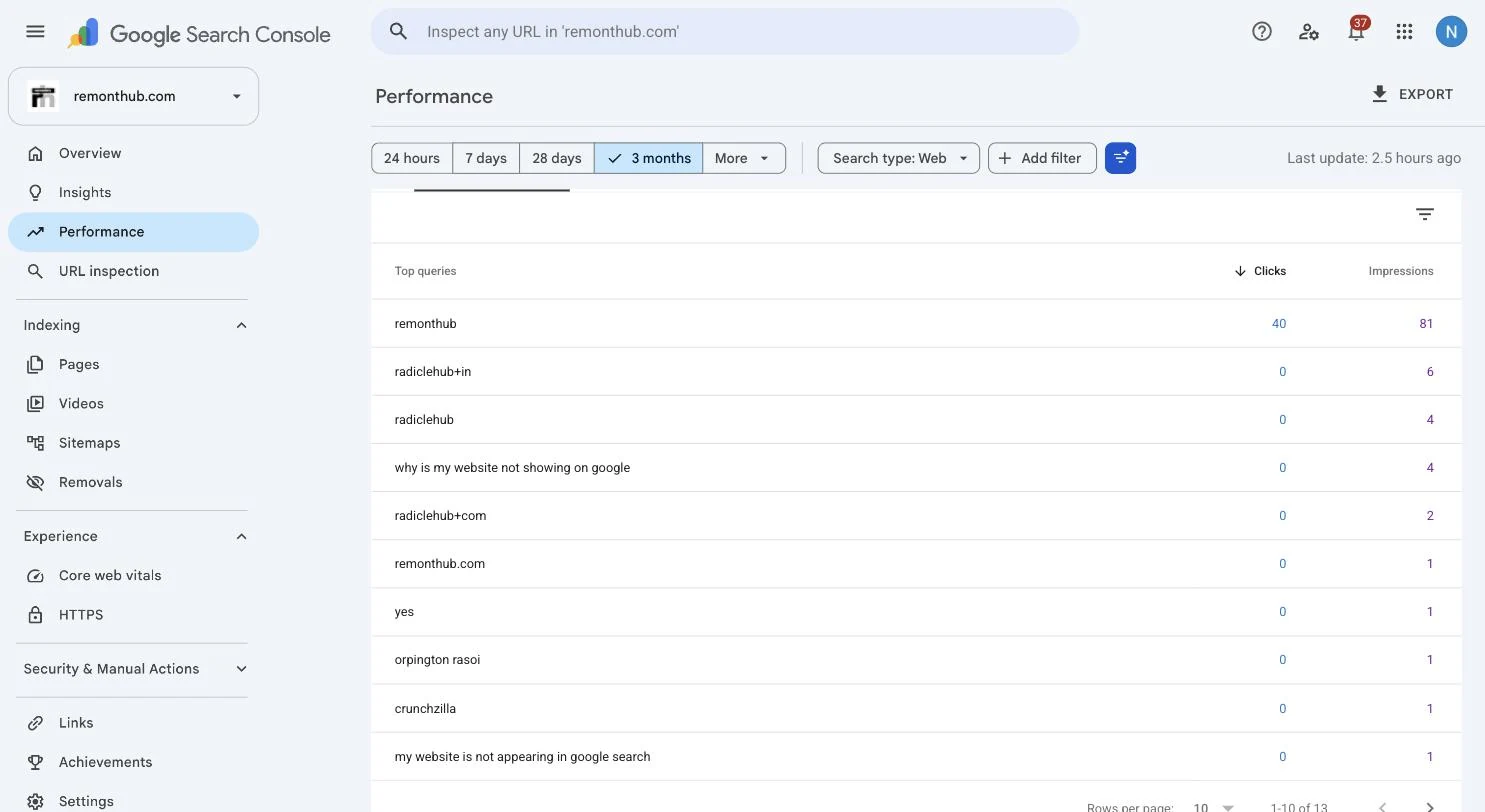
- “What are we appearing for now that we were not before?” New non-branded queries can reveal progress before meaningful clicks arrive.
The realistic timeline—so nobody oversells you
| What | Useful planning range |
|---|---|
| New page gets indexed | Hours to several weeks |
| Page starts appearing at low positions | Often 2–8 weeks |
| Meaningful movement on low-competition terms | Often 3–6 months |
| Competitive commercial terms | Often 6–12+ months |
| Off-page authority becoming visible in results | Six months to years |
These are planning ranges, not guarantees. Timing depends on the site, topic, competition, crawl patterns, resources and quality of execution.
SEO is a compounding asset, not a short campaign. It can be slow before it becomes significant. Anyone promising a fixed first-page date is selling certainty the channel does not offer.
Questions we get a lot
What's the difference between technical, on-page and off-page SEO?
Technical SEO is whether search engines can reach, read and load your site. On-page SEO is whether each page clearly and usefully answers what people searched for. Off-page SEO is whether other credible websites link to and mention you. All three matter: technical is the foundation, on-page is the largest ongoing workload and off-page is usually the slowest to build.
What are Core Web Vitals in simple terms?
They are three measurements of whether a page feels fast, responsive and stable to a real visitor. A good experience is LCP of 2.5 seconds or less, INP of 200 milliseconds or less and CLS of 0.1 or less, measured at the 75th percentile. Google uses Core Web Vitals in its ranking systems, but relevance and usefulness still matter more than chasing a perfect score.
Why does Search Console say "not enough usage data" for Core Web Vitals?
The report uses Chrome User Experience Report data from real visits. A new property, or a URL group without enough eligible real-user data for the relevant device type, may show no data. That is common on small or low-traffic sites. PageSpeed Insights can still run an on-demand Lighthouse lab test, although its real-user section also depends on available Chrome UX Report data.
How much do SEO tools cost?
The essential tools—Google Search Console, PageSpeed Insights, Google Analytics, Google Business Profile and Bing Webmaster Tools—are free. As of August 2026, Ahrefs starts at $29 per month for Starter and $129 for Lite, while the Semrush SEO Toolkit starts at $139.95 per month for Pro. Most small businesses do not need two overlapping paid suites.
Why did my rankings drop when we didn't change anything?
Google changes its ranking systems throughout the year, including broad core updates that are not targeted at one site. Compare the timing with Google's Search Status Dashboard and review longer trends before assuming something broke. A core-update decline is still a reason to assess whether other pages now provide a more helpful result.
Do I need to hire an SEO team or use an agency?
It depends on scale and how central organic search is to revenue. SEO spans development, content, outreach and analysis, which one hire rarely covers equally well. An agency can provide the mix without four salaries; an in-house team makes sense when the channel is strategic enough to justify dedicated specialists. A hybrid model is often practical.
How long does SEO take to work?
There is no guaranteed timetable. A new page can be indexed in hours or take several weeks, while meaningful movement for a low-competition topic often takes months. Competitive commercial searches can take six to twelve months or longer. Treat these as planning ranges, not promises, and judge progress through three-month trends.